
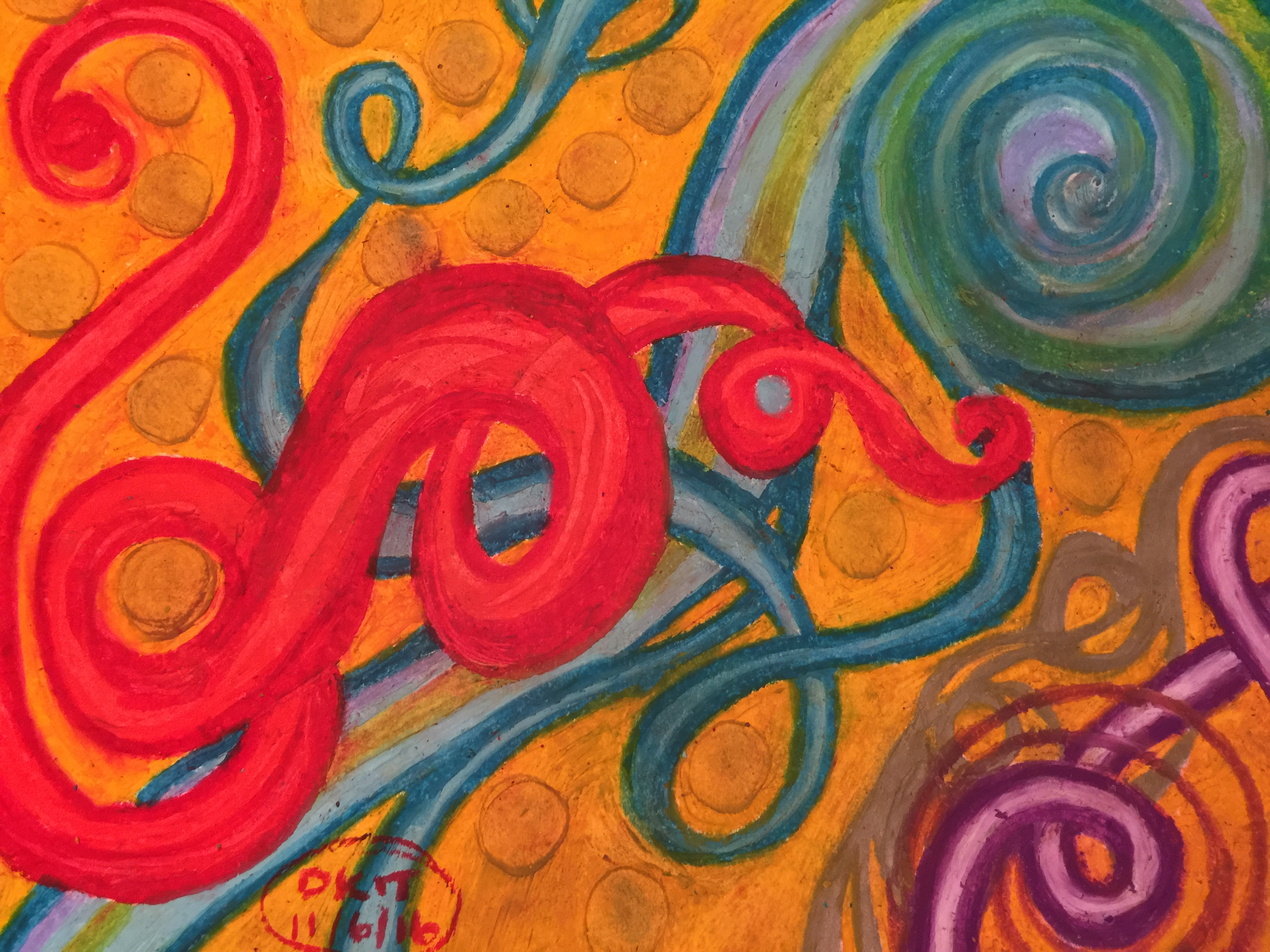
Art as Therapy- A Self-Led Form of Healing

In a previous post on the Internal Family Systems (IFS) model of psychotherapy, which has been widely used to treat depression, I said I would devote a series of future posts to introducing Self-led activities that enable you to be your own greatest healer. Forms of creative expression such as painting, drawing, writing, dance, or music are ideal mediums for expression of the Self. Meditation, yoga and other forms of physical expression are also Self-led. This post about visual art, also referred to as expressive art or art psychology, is the first post in the series. In case you do not feel like reading my post on IFS, I will provide a brief introduction to some related terms that I use throughout this post. If you prefer to skip to the body of this post, click here. The Self is the “real you.” If you are spiritually inclined, you may think of the Self (with a capital “S”) as your core personality, your essence or your soul. Richard Schwartz, Ph.D., founder of IFS, says that the Self is characterized by “calmness, curiosity, clarity, compassion, confidence, creativity, courage, and connectedness.” Any activity that supports your ability to tap into your Self and enables your parts to be heard will clear your personal path toward healing and recovery. When we are born, all we are is “Self,” but as we live our lives and experience different types of loss, abuse, or any number of emotional traumas, we develop parts whose purpose is to protect us from ever entering situations that re-trigger the original source of that pain. As a result, each of us has an inner family of parts or sub-personalities that conflict with each other and cause suffering. Each of our parts has a voice and the goal of IFS is to be Self-led or rather for the Self to speak for or on behalf of each of those voices rather than from them. One way to tell if you are engaging in a Self-led activity is if you lose track of time. I often need to set a timer when I write or paint because I can spend four hours on a project and feel like only fifteen minutes went by. That’s because I am engaging in an activity that feeds my soul. In contrast, fifteen minutes at my current day job feels like four hours. Art is high on the list of Self-led activities and has long been recognized as a form of healing, particularly for people struggling with depression, post-traumatic stress and other mental health conditions. Art can be used as a tool to complement your journey of treatment and to help you maintain your gains. Art is therapeutic whether you are creating or viewing it. If you don’t have the time to create art, surround yourself with beautiful images that bring you inner peace and clarity; however, by the time you reach the end of this post, I hope you will see how empowering and uplifting it can be to put your own mark on a blank canvas or sketch pad. You don’t need to be “artistically talented” to reap the benefits of the creative process. The very act of expressing your feelings visually has been shown to be incredibly therapeutic. Your art doesn’t need to be museum quality for it to have meaning and value to you and those you care about. I have loved art ever since I was old enough to pick up a paintbrush. Art and writing bring me more joy than almost anything else.  Art is a key component of my self care toolbox to borrow a term from Kyri, one of our blog contributors who is also a visual artist. I am generally very extroverted, but there are times when I don’t feel like talking to anyone and I only want the company of my Self, some soothing music and my oil pastels. We’ve all heard the saying that “a picture is worth a thousand words.” While this may sound cliché, it is very true for me. Art is a way of showing my feelings when telling them to someone is difficult. Even for a person who loves to write as much as I do, there are times when the English language is inadequate to articulate my inner world. When I am experiencing conflicting emotions that I don’t have words for, art is an ideal way to give a voice to the parts of me that need to be heard. Sometimes I already know what my parts have to say (i.e. I am angry, hurt, etc.) and I am able to quickly express that on a canvas. Other times, my parts surprise me with their wisdom and the product I end up with is very different from what I originally envisioned. The best part about creating art is that there is no judgment. You can never be wrong. Unlike math where there is only one correct answer, art has no rules or formulas except that there are three primary colors. There is tremendous freedom in that. Most of my art is abstract for that reason. I relish the fact that art forces me to put my linear, analytical mind aside and accept that it’s okay to not know where I am going. I use art as a way to escape the rational trappings of my thoughts. Art reminds me that my destination will be more beautiful than I had planned if I embrace the uncertainty of all the colors in my journey. I am a person who plans out my calendar several weeks in advance and if I have an important meeting, I try to prepare for every possible outcome with data and citations. Art asks me to let go, embrace the unexpected, enjoy the process of Self-discovery and release my need to control the outcome of everything. Uncertainty can feel unsafe, but it is necessary for beauty to unfold. There was a time when my OCD prevented me from doing art because I didn’t want to get my hands dirty from the paints. Now, I rejoice in mixing oil pastels with my fingers- my current medium of choice. The messier it is, the more satisfying. In other areas of my life, I like to keep things clean and orderly. But when I am doing art, suddenly it feels acceptable to let go and make a mess. There is something so liberating about giving myself permission to do that. Another reason I prefer abstract art is that I believe it is easier for the viewer to find something within it that speaks to them, perhaps a meaning the artist did not think of when creating it. Each person views the same piece of art differently. Sometimes my own art work means something different to me a week later than it did when I created it. At the same time, I am a perfectionist and my own worst critic. If I finish a painting that didn’t turn out the way I wanted and there is no way to “fix” it, I am tempted to throw it in the trash because I didn’t fulfill my own expectations. When this critical part of me emerges, I force myself to put my art away in a safe place and then look at it a few days later. After having some space from the painting, I usually like it. It seems like someone else should have made it and yet apparently I did. Sometimes we need space from our parts before we can look at them without judgment. I don’t only make art when my parts are in conflict. I also make art when I am happy for the sole purpose of expressing my Self and the joy and privilege of simply being alive. Reminding myself of the beauty of life helps me remain grateful to be here, which gives me a buffer when hard times inevitably roll around. The act of practicing gratitude is another Self-led activity that can prevent depression. I will discuss gratitude in a later post. If you are depressed, anxious or otherwise struggling, I encourage you to pick up some art supplies and start painting or drawing. Or buy some art to hang in your home that lifts your spirits. If art has helped you, feel free to e-mail me an image of your work and I will feature it in a new post (anonymously if you prefer). Photo credit: Me!

Relapse and Climbing Back Up the Hill to Recovery

One of the most discouraging parts of having a mental illness is when you think you have conquered your symptoms for good, only to fall back into that deep black hole, and then you have to start the journey of treatment all over again. You have to go through the process of finding a therapist, dealing with health insurance, and navigating the healthcare system, not to mention doing all of this while you are sick and overwhelmed with life unless you are lucky enough to have someone else do it on your behalf. Once Voices for Health is fully launched, we will be able to take care of all these details for you so that you can just focus on getting better. But for now, I want to devote a post to sharing my experience with relapse and recovery since this is a topic that virtually everyone with a mental illness can relate to. Pretty soon, Voices for Health will have an e-Support Forum up where people can talk with others who are experiencing similar challenges. In the meantime, if you are struggling with any of the above, feel free to contact me. I’m always here if you need support. Believe me, I “get it.” If you prefer to skip past my story below and just read my message of hope to those of you who are discouraged about the prospect of going through treatment again, click here. In a future blog post, I will offer tips for recognizing when you are about to go down that slippery slope, so that you don’t relapse again. When my OCD symptoms started to reappear at age sixteen, I was lazy and gave into my compulsions. After fighting so hard for my life I thought all the hard work was done. I had been virtually symptom free for close to two years and it never occurred to me that OCD could come back. I thought I had conquered my illness for good. I didn’t fully understand that once you have OCD, you always have it. It’s a chronic illness. You can put your symptoms into remission, but to be “OCD free” you must constantly monitor and control your tendencies. You can never let your guard down. The same is true with depression. My mother was horrified. She had also thought that my OCD was gone for good and was puzzled by how it came back full force. She hoped I had learned enough from my work in therapy so that I could do treatment on my own, but the obsessions intensified so quickly that by the middle of my junior year of high school she was back on the phone with my therapist, Denise asking for help. I’ve never felt any shame about having OCD. I never asked to have it. I was born with it. But I did feel shame in allowing it to come back, especially after being featured as a success story on Inside Edition the previous year. I didn’t think I deserved to be on that show. How could I tell other people to work on their problems when I couldn’t keep my own under control? What kind of role model was I? I became depressed again which only made my OCD worse. Denise told me and my parents that it is common for people who have successfully dealt with OCD to relapse after a period of remission because they feel like they are on top of the world and are no longer vigilant about managing their symptoms. I wanted to go back on national television and issue that warning to people with OCD across the nation. “Don’t let this happen to you. Don’t be like me. Once you get better, make sure you stay better.” This time, it was harder for me to find the motivation to work on my OCD. As bad as my symptoms were, they were not as severe as when I was thirteen. Back then, I had no life at all and Cognitive Behavioral Therapy was my only hope for ever leaving the house or having any personal hygiene. Now, my OCD made life miserable, but it was easier to put off doing exposures because I was able to live with OCD even though it was significantly interfering with my life. My motivation was strongest when I hit rock bottom. Still, I recognized that I needed to get to work again or else before long I would hit rock bottom. This was no way to live. It had taken me two years to get better the first time and it took me a year to get better again, but I did it. Eventually, I will have more full story on this site. A part of me wondered what is the point of getting better if I’m just going to keep getting sick? If relapse is always a possibility, why not just end it all? I didn’t want my life to be a constant cycle of treatment and recovery. Denise told me that mental illness is like falling down a slippery slope. She assured me that if I remain vigilant about managing my symptoms and ask for help when I first notice I am sliding down the hill instead of waiting until I’m half way down, I will never relapse again. It’s much harder to get better when you have to climb all the way back up the hill. If you seek help as soon as you start sliding, you won’t have to start at square one. As usual, Denise was right. I am now 33 and have not relapsed since I was sixteen. There have been times when I came close, but I have always sought help for myself before things reached that tipping point. I am not symptom free, although I hide my symptoms well enough so that no one realizes what I am truly going through on the inside every day. What makes me a “survivor” of mental illness is that I manage my symptoms so that they don’t take over my life and interfere with my ability to function. I have worked too hard and have way too much to lose to throw it all away. And the same applies to you. My mother (who died when I was 20) sacrificed much of her life to make sure I had a chance to live. I owe it to her and to myself to not give into my depression and OCD. I have my career, my apartment, my family and friends. Those things are worth fighting for. I am worth fighting for. So, if you have relapsed and are feeling discouraged by the prospect of going through treatment all over again, my message to you is this: Don’t feel ashamed like I did. You are human. You thought you had conquered this thing for good, but then you fell down the slippery slope before you realized what was happening. Don’t beat yourself up and feel guilty. That will just make things worse. What matters now is that you do something to fix it. Don’t hope your symptoms will improve on their own because they won’t. Now is the time to take action so that you don’t keep falling. You owe it to yourself to get your life back. And once you get better, you don’t have to go through this hell again. Your life doesn’t need to be a never-ending cycle of treatment and recovery. The key is to find a good therapist who can give you a toolbox of strategies to use when your symptoms start to return. That way you can manage them on your own. And if you feel like you can’t do it alone, there is no shame in going back into therapy. Whatever you do, don’t isolate yourself. If you are willing to open up, most people will be compassionate and the ones who make fun of you were never true friends to begin with. They aren’t worth your time. I firmly believe that the outcome of our lives is determined not by the hand of cards we are dealt, but by how we play those cards. Fate can send us disappointments and opportunities, but it is up to us to act on them, changing the things we can and accepting what is beyond our control. If you fold your hand too early when life gets difficult you will never know what is waiting for you at the bottom of the deck. I would rather stay in the game and see what happens. Otherwise, I will live the rest of my life wondering “what if?” What if I had taken that chance? If you lose the first hand, fine. Try again. If your symptoms come out of remission, get back to work. Keep playing until the cards are gone and your natural time on this earth is up. There is no reason why anyone should ever be ashamed of having a mental illness. No one asks to have OCD or depression anymore than anyone asks to have cancer. The only thing to be ashamed of is not doing something about it. You just have to take the first step. You are worth it. You are worth taking that chance. Photo credit: Paxson Woelber

LOAD MORE