
Art as Therapy- A Self-Led Form of Healing

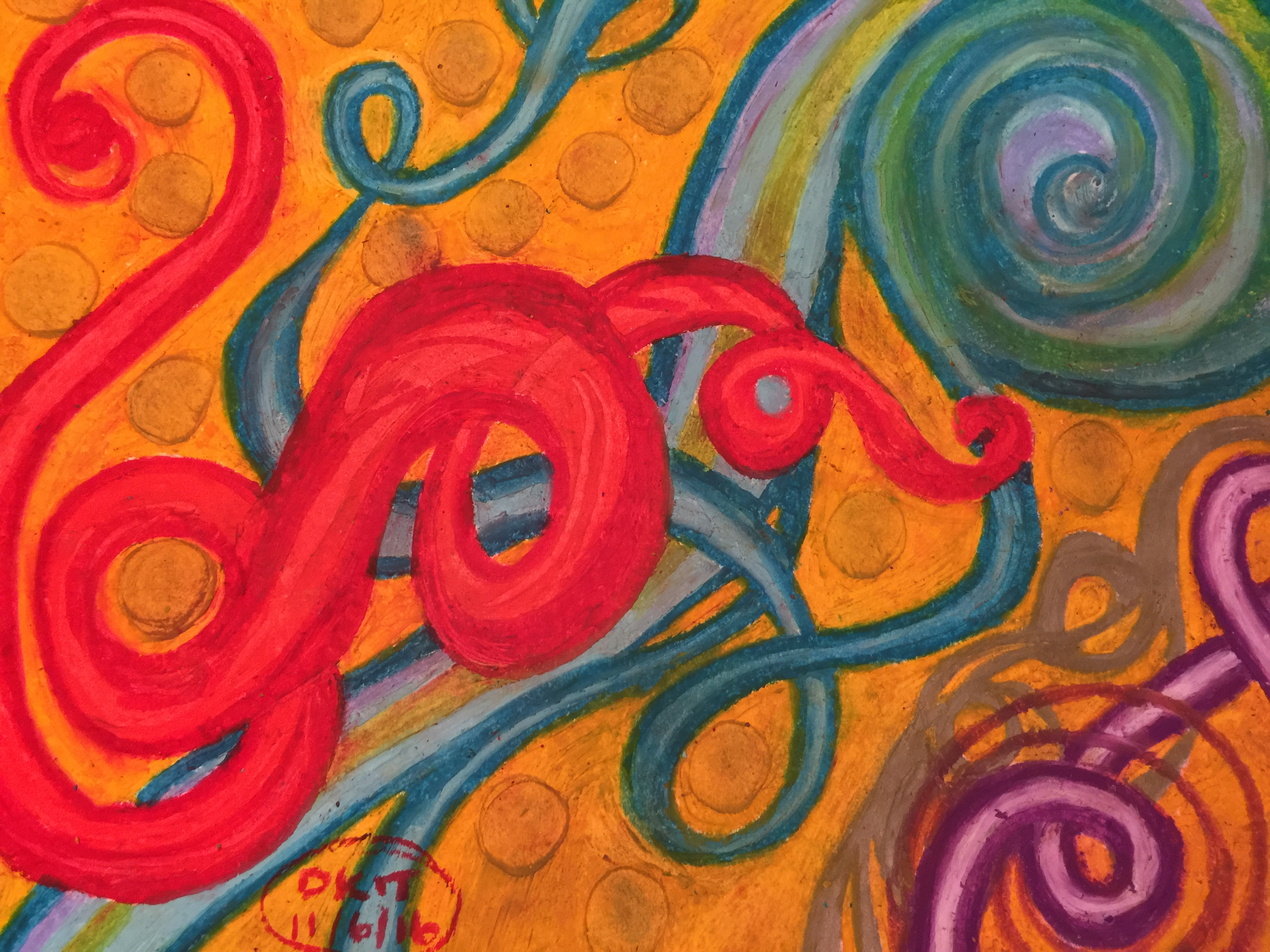
In a previous post on the Internal Family Systems (IFS) model of psychotherapy, which has been widely used to treat depression, I said I would devote a series of future posts to introducing Self-led activities that enable you to be your own greatest healer. Forms of creative expression such as painting, drawing, writing, dance, or music are ideal mediums for expression of the Self. Meditation, yoga and other forms of physical expression are also Self-led. This post about visual art, also referred to as expressive art or art psychology, is the first post in the series. In case you do not feel like reading my post on IFS, I will provide a brief introduction to some related terms that I use throughout this post. If you prefer to skip to the body of this post, click here. The Self is the “real you.” If you are spiritually inclined, you may think of the Self (with a capital “S”) as your core personality, your essence or your soul. Richard Schwartz, Ph.D., founder of IFS, says that the Self is characterized by “calmness, curiosity, clarity, compassion, confidence, creativity, courage, and connectedness.” Any activity that supports your ability to tap into your Self and enables your parts to be heard will clear your personal path toward healing and recovery. When we are born, all we are is “Self,” but as we live our lives and experience different types of loss, abuse, or any number of emotional traumas, we develop parts whose purpose is to protect us from ever entering situations that re-trigger the original source of that pain. As a result, each of us has an inner family of parts or sub-personalities that conflict with each other and cause suffering. Each of our parts has a voice and the goal of IFS is to be Self-led or rather for the Self to speak for or on behalf of each of those voices rather than from them. One way to tell if you are engaging in a Self-led activity is if you lose track of time. I often need to set a timer when I write or paint because I can spend four hours on a project and feel like only fifteen minutes went by. That’s because I am engaging in an activity that feeds my soul. In contrast, fifteen minutes at my current day job feels like four hours. Art is high on the list of Self-led activities and has long been recognized as a form of healing, particularly for people struggling with depression, post-traumatic stress and other mental health conditions. Art can be used as a tool to complement your journey of treatment and to help you maintain your gains. Art is therapeutic whether you are creating or viewing it. If you don’t have the time to create art, surround yourself with beautiful images that bring you inner peace and clarity; however, by the time you reach the end of this post, I hope you will see how empowering and uplifting it can be to put your own mark on a blank canvas or sketch pad. You don’t need to be “artistically talented” to reap the benefits of the creative process. The very act of expressing your feelings visually has been shown to be incredibly therapeutic. Your art doesn’t need to be museum quality for it to have meaning and value to you and those you care about. I have loved art ever since I was old enough to pick up a paintbrush. Art and writing bring me more joy than almost anything else.  Art is a key component of my self care toolbox to borrow a term from Kyri, one of our blog contributors who is also a visual artist. I am generally very extroverted, but there are times when I don’t feel like talking to anyone and I only want the company of my Self, some soothing music and my oil pastels. We’ve all heard the saying that “a picture is worth a thousand words.” While this may sound cliché, it is very true for me. Art is a way of showing my feelings when telling them to someone is difficult. Even for a person who loves to write as much as I do, there are times when the English language is inadequate to articulate my inner world. When I am experiencing conflicting emotions that I don’t have words for, art is an ideal way to give a voice to the parts of me that need to be heard. Sometimes I already know what my parts have to say (i.e. I am angry, hurt, etc.) and I am able to quickly express that on a canvas. Other times, my parts surprise me with their wisdom and the product I end up with is very different from what I originally envisioned. The best part about creating art is that there is no judgment. You can never be wrong. Unlike math where there is only one correct answer, art has no rules or formulas except that there are three primary colors. There is tremendous freedom in that. Most of my art is abstract for that reason. I relish the fact that art forces me to put my linear, analytical mind aside and accept that it’s okay to not know where I am going. I use art as a way to escape the rational trappings of my thoughts. Art reminds me that my destination will be more beautiful than I had planned if I embrace the uncertainty of all the colors in my journey. I am a person who plans out my calendar several weeks in advance and if I have an important meeting, I try to prepare for every possible outcome with data and citations. Art asks me to let go, embrace the unexpected, enjoy the process of Self-discovery and release my need to control the outcome of everything. Uncertainty can feel unsafe, but it is necessary for beauty to unfold. There was a time when my OCD prevented me from doing art because I didn’t want to get my hands dirty from the paints. Now, I rejoice in mixing oil pastels with my fingers- my current medium of choice. The messier it is, the more satisfying. In other areas of my life, I like to keep things clean and orderly. But when I am doing art, suddenly it feels acceptable to let go and make a mess. There is something so liberating about giving myself permission to do that. Another reason I prefer abstract art is that I believe it is easier for the viewer to find something within it that speaks to them, perhaps a meaning the artist did not think of when creating it. Each person views the same piece of art differently. Sometimes my own art work means something different to me a week later than it did when I created it. At the same time, I am a perfectionist and my own worst critic. If I finish a painting that didn’t turn out the way I wanted and there is no way to “fix” it, I am tempted to throw it in the trash because I didn’t fulfill my own expectations. When this critical part of me emerges, I force myself to put my art away in a safe place and then look at it a few days later. After having some space from the painting, I usually like it. It seems like someone else should have made it and yet apparently I did. Sometimes we need space from our parts before we can look at them without judgment. I don’t only make art when my parts are in conflict. I also make art when I am happy for the sole purpose of expressing my Self and the joy and privilege of simply being alive. Reminding myself of the beauty of life helps me remain grateful to be here, which gives me a buffer when hard times inevitably roll around. The act of practicing gratitude is another Self-led activity that can prevent depression. I will discuss gratitude in a later post. If you are depressed, anxious or otherwise struggling, I encourage you to pick up some art supplies and start painting or drawing. Or buy some art to hang in your home that lifts your spirits. If art has helped you, feel free to e-mail me an image of your work and I will feature it in a new post (anonymously if you prefer). Photo credit: Me!
Self Care Toolbox

This post was submitted by "Kyri L.," our first outside contributor to this blog. Kyri successfully manages "a cocktail of disorders" while holding down a full-time job at an IP firm, thriving as a free lance artist and leading a fulfilling social life. Kyri's five tools for self care are excellent strategies for loving yourself while you are in the midst of treatment as well as maintaining your gains so that you don't relapse. Thank you, Kyri for sharing your voice! I’m writing this on a bad day. Font size is set to 14, so I don’t have to squint to see my text. I haven’t gone to see an optometrist in a few years, and the fibromyalgia is making my vision a little unstable sometimes. I cried a lot today too, and my eyes are unhappy with focusing. I feel an anxiety attack crawling at the base of my skull. Thinking about chopping vegetables for dinner makes me want to lie down and nap for a long, long time. It’s on these days, the ones where I break down and hope nobody notices, that it’s most important to focus on the positive and put on a brave face. You have to do that, when you have the miserable cocktail of disorders that I do: fibromyalgia and hypermobility syndrome, diagnosed in the last few months, and some older arrows in my side, Major Depressive Disorder, General Anxiety Disorder, Post Traumatic Stress Disorder, Irritable Bowel Syndrome, and some mild Obsessive Compulsive Disorder to balance it all out. These are things that influence me, that are part of who I am and how I live, but they don’t define me; I may struggle to stay on top, but the fact of the matter is, I win against this health-beast more days than I lose. I’m a champion for getting up every day, getting dressed, going to work. For going to each and every one of my appointments on time (as long as the subway is running smoothly). For trying again and again to find just the right way to dodge symptom bullets and sneak more productivity into good days. Not just a survivor, but a champion of my circumstance. The best things in my self-care toolbox are as follows: 1. Humility. Being disabled is embarrassing, awkward, and hard. It involves telling strangers every day that I have limitations. But because I’ve accepted this aspect of my life, because I don’t cling to pride that will harm not just my mind, but my body, I’m able to reach out and get help when I need it. I ask for a seat on the subway each and every day on my way to work, and for that I get to save energy for more things I want to do. It was incredibly hard at first to speak up and ask for that help. It took me promising myself I would ask every day, even on good days, until it became a force of habit. You don’t have to disclose everything to get help, either. I usually say, “Can I have someone’s seat? I have bad knees,” and that’s enough. Maybe the stranger who gives me their seat is imagining I was an extreme sports junkie and messed up my knees being a total badass. 2. Forgiveness, of the self and others. It’s so, so necessary to be kind to yourself, to love yourself, but I think the best manifestation of those things is self-forgiveness. Don’t beat yourself up for missteps. If I didn’t brush my teeth today, that’s okay. I can always brush them tomorrow. If I forgot to send a card to a loved one for their birthday, I’m not a bad person. My illnesses just make me forgetful, and I’ll write it down next time. Forgiving yourself the mistakes you’d forgive of others is one of the single best things you can do to stay positive and on an upward path. One way I like to do this is to personify each of my issues into a dog. Sometimes the dog won’t do what you want it to, or even cause major problems, but it’s very hard to stay mad at a dog. It isn't malicious. It didn’t do anything for the sole purpose of making your life miserable. It’s just in its nature sometimes. And that’s okay. You’ll run into people who don’t understand your illnesses, too. It’s better to forgive those people, even if they’re rude or even callous, whether they meant to be or not. Whatever they did might have been horrible, but it’s better to accept it and move onward. Holding grudges takes up mental space that you don’t have, and could very well make your health worse. 3. Prioritizing everything. I’m an artist, so this can be a hard one when I have five different creative projects bouncing in my brain all wanting to come out at once. The only way to efficiently use the energy you have though, is to decide what’s important to you, what isn’t, and ranking those on a day to day basis. It can be gut wrenching to admit to yourself that you might not get to reading that classic novel until a year from now, because other things are more pressing, but it keeps your life concrete and easy to manipulate later if things need to change. It makes it a lot easier to block out your energy, and know immediately what tasks you can abandon on bad days without guilt. Being realistic about what you can and can’t accomplish, and being up-front to others about those limitations, can take a lot of the stress out of your life. 4. Recuperation Day. Every weekend, usually on Sundays, I do almost nothing. I let myself sleep all day if I need to. I don’t get dressed. I don’t do anything that requires much concentration or energy. It’s a day for recharging, for fortifying myself for the next week. I know it’s there for me at the end of every week, so if Wednesday is really hard (today is Wednesday), I know I just have a few more days until I have no responsibilities except for listening to my body’s needs. This is one of the biggest things that got me through college to graduate cum laude. Scheduling in a day to do absolutely nothing helps keep my energy reserves from depleting entirely. Of course, you have to be stricter on yourself every other day of the week. That goes back to priority: in order to have Sundays off, you have to prioritize tasks to be done during the week ahead of time. 5. Talk about it! If you don’t feel comfortable being open to everyone about your struggles, find a few people who you trust enough to talk to and verbalize it. It really helps me put things into perspective and understand them better if I say it out loud. It’s best to find people who aren’t directly responsible for helping you, though, so they don’t feel an emotional burden from it. Online communities are great places to find people with similar experiences, or who are just willing to listen, and there’s very little pressure involved in the conversation. It helps me to listen to other people’s problems too. If someone is open to advice, giving it to them is something that makes my own problems feel a little easier to tackle. The above is not an exhaustive list, but those are some core things that keep me going. I may have to take my life day by day, but even with my extra challenges, I’ve accomplished amazing things. I graduated cum laude from college with multiple awards and two minors. I’ve been in a few gallery shows with recent work, and have a great community of artist friends to keep me creating something every week. My tentative beginnings at an Etsy business have been more successful than I thought they’d be. I have a great office job at an IP firm that truly values its workers, something that has proved invaluable to me as I’ve navigated the minefield of new diagnoses. I have a happy little family in my girlfriend and our odd-ball cat (who, funny enough, is also disabled - he has FIV, asthma, really bad near vision, and some anxiety and battle scars from living on the streets before we got him). I have three siblings who are the world to me, and a mom who will call any time I need a shoulder to cry on. You know, after all this, maybe today isn’t so bad after all.  

LOAD MORE