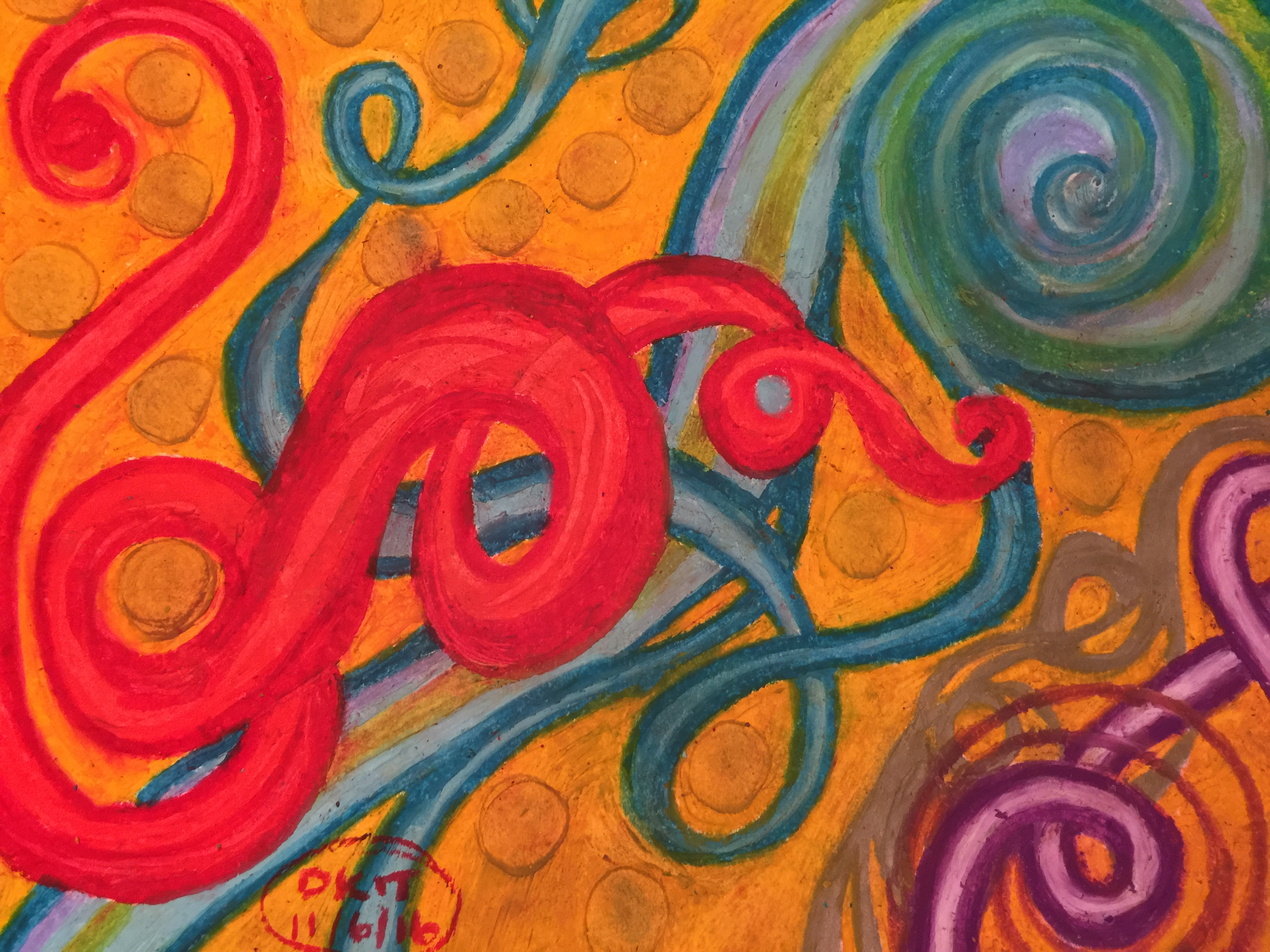
Art as Therapy- A Self-Led Form of Healing

In a previous post on the Internal Family Systems (IFS) model of psychotherapy, which has been widely used to treat depression, I said I would devote a series of future posts to introducing Self-led activities that enable you to be your own greatest healer. Forms of creative expression such as painting, drawing, writing, dance, or music are ideal mediums for expression of the Self. Meditation, yoga and other forms of physical expression are also Self-led. This post about visual art, also referred to as expressive art or art psychology, is the first post in the series. In case you do not feel like reading my post on IFS, I will provide a brief introduction to some related terms that I use throughout this post. If you prefer to skip to the body of this post, click here. The Self is the “real you.” If you are spiritually inclined, you may think of the Self (with a capital “S”) as your core personality, your essence or your soul. Richard Schwartz, Ph.D., founder of IFS, says that the Self is characterized by “calmness, curiosity, clarity, compassion, confidence, creativity, courage, and connectedness.” Any activity that supports your ability to tap into your Self and enables your parts to be heard will clear your personal path toward healing and recovery. When we are born, all we are is “Self,” but as we live our lives and experience different types of loss, abuse, or any number of emotional traumas, we develop parts whose purpose is to protect us from ever entering situations that re-trigger the original source of that pain. As a result, each of us has an inner family of parts or sub-personalities that conflict with each other and cause suffering. Each of our parts has a voice and the goal of IFS is to be Self-led or rather for the Self to speak for or on behalf of each of those voices rather than from them. One way to tell if you are engaging in a Self-led activity is if you lose track of time. I often need to set a timer when I write or paint because I can spend four hours on a project and feel like only fifteen minutes went by. That’s because I am engaging in an activity that feeds my soul. In contrast, fifteen minutes at my current day job feels like four hours. Art is high on the list of Self-led activities and has long been recognized as a form of healing, particularly for people struggling with depression, post-traumatic stress and other mental health conditions. Art can be used as a tool to complement your journey of treatment and to help you maintain your gains. Art is therapeutic whether you are creating or viewing it. If you don’t have the time to create art, surround yourself with beautiful images that bring you inner peace and clarity; however, by the time you reach the end of this post, I hope you will see how empowering and uplifting it can be to put your own mark on a blank canvas or sketch pad. You don’t need to be “artistically talented” to reap the benefits of the creative process. The very act of expressing your feelings visually has been shown to be incredibly therapeutic. Your art doesn’t need to be museum quality for it to have meaning and value to you and those you care about. I have loved art ever since I was old enough to pick up a paintbrush. Art and writing bring me more joy than almost anything else.  Art is a key component of my self care toolbox to borrow a term from Kyri, one of our blog contributors who is also a visual artist. I am generally very extroverted, but there are times when I don’t feel like talking to anyone and I only want the company of my Self, some soothing music and my oil pastels. We’ve all heard the saying that “a picture is worth a thousand words.” While this may sound cliché, it is very true for me. Art is a way of showing my feelings when telling them to someone is difficult. Even for a person who loves to write as much as I do, there are times when the English language is inadequate to articulate my inner world. When I am experiencing conflicting emotions that I don’t have words for, art is an ideal way to give a voice to the parts of me that need to be heard. Sometimes I already know what my parts have to say (i.e. I am angry, hurt, etc.) and I am able to quickly express that on a canvas. Other times, my parts surprise me with their wisdom and the product I end up with is very different from what I originally envisioned. The best part about creating art is that there is no judgment. You can never be wrong. Unlike math where there is only one correct answer, art has no rules or formulas except that there are three primary colors. There is tremendous freedom in that. Most of my art is abstract for that reason. I relish the fact that art forces me to put my linear, analytical mind aside and accept that it’s okay to not know where I am going. I use art as a way to escape the rational trappings of my thoughts. Art reminds me that my destination will be more beautiful than I had planned if I embrace the uncertainty of all the colors in my journey. I am a person who plans out my calendar several weeks in advance and if I have an important meeting, I try to prepare for every possible outcome with data and citations. Art asks me to let go, embrace the unexpected, enjoy the process of Self-discovery and release my need to control the outcome of everything. Uncertainty can feel unsafe, but it is necessary for beauty to unfold. There was a time when my OCD prevented me from doing art because I didn’t want to get my hands dirty from the paints. Now, I rejoice in mixing oil pastels with my fingers- my current medium of choice. The messier it is, the more satisfying. In other areas of my life, I like to keep things clean and orderly. But when I am doing art, suddenly it feels acceptable to let go and make a mess. There is something so liberating about giving myself permission to do that. Another reason I prefer abstract art is that I believe it is easier for the viewer to find something within it that speaks to them, perhaps a meaning the artist did not think of when creating it. Each person views the same piece of art differently. Sometimes my own art work means something different to me a week later than it did when I created it. At the same time, I am a perfectionist and my own worst critic. If I finish a painting that didn’t turn out the way I wanted and there is no way to “fix” it, I am tempted to throw it in the trash because I didn’t fulfill my own expectations. When this critical part of me emerges, I force myself to put my art away in a safe place and then look at it a few days later. After having some space from the painting, I usually like it. It seems like someone else should have made it and yet apparently I did. Sometimes we need space from our parts before we can look at them without judgment. I don’t only make art when my parts are in conflict. I also make art when I am happy for the sole purpose of expressing my Self and the joy and privilege of simply being alive. Reminding myself of the beauty of life helps me remain grateful to be here, which gives me a buffer when hard times inevitably roll around. The act of practicing gratitude is another Self-led activity that can prevent depression. I will discuss gratitude in a later post. If you are depressed, anxious or otherwise struggling, I encourage you to pick up some art supplies and start painting or drawing. Or buy some art to hang in your home that lifts your spirits. If art has helped you, feel free to e-mail me an image of your work and I will feature it in a new post (anonymously if you prefer). Photo credit: Me!

Loving All Your Parts: An Introduction to IFS

"The first step is to distinguish the loving parts of your personality that are active from the frightened parts of your personality that are active- in other words, to learn to distinguish love from fear in you. The second step is to choose love no matter what." - Gary Zukav At some point, you have probably had a frustrating conversation while trying to help a friend who was going through a difficult time. This person did not seem to be themselves, at least not the person you believe they truly are inside. From your perspective, this person was acting out of character and you felt like you were talking to someone else. Did they want to listen to you, but weren’t able to? Did you sense that there were things they wanted to tell you, but did not have words for? Or that the words they said were cover-ups for a truth that was too painful for them to acknowledge to themselves, let alone to you? The Internal Family Systems (IFS) model of psychotherapy would say that you were talking to a “part” of this person, not to their “Self.” This part took over the conversation as a form of protection or a defense mechanism due to past traumas and emotional injuries they have not dealt with. An IFS therapist would work with your friend to see what parts needed to be heard, so that they could then release these traumas and be set free. In this post, I am going to introduce you to the concepts behind IFS and why I believe it is the best tool for treating depression and preventing relapses . IFS is an evidence-based therapeutic model that has been shown to improve: phobia, panic, and generalized anxiety disorders and symptoms; physical health conditions and symptoms; personal resilience/self-concept; and depression and depressive symptoms. It is now being applied to other fields outside the mental health world, including the medical field, executive and health coaching, legal mediation and schools. IFS has also been used in peacemaking efforts, and by military chaplains and prison counselors. At the end of this post, I have included some resources where you can learn more about IFS. IFS is a teaching of self-love and is based on the premise that you have the power to be your own greatest healer. This is made possible by tapping into your “Self (with a capital “S”) or the “real you.” If you are spiritually inclined, you may think of the Self as your core personality, your inner essence or your soul. Richard Schwartz, Ph.D., founder of IFS, says that the Self is characterized by “calmness, curiosity, clarity, compassion, confidence, creativity, courage, and connectedness.” When we are born, all we are is “Self,” but as we live our lives and experience different types of loss, abuse, or any number of emotional traumas, we develop parts whose purpose is to protect us from ever entering situations that re-trigger the original source of that pain. As a result, each of us has an inner family of parts or sub-personalities that conflict with each other and cause suffering. If you have mental health conditions such as OCD that require their own specialized types of therapy such as Cognitive Behavioral Therapy (CBT), IFS can be used as a complement to your treatment plan for those conditions so that you have the self-love to see your Self through to recovery. There are different types of parts:

  • “Exiles”- our wounded parts that carry the emotions, memories and sensations from traumatic events (such as hurt, grief, humiliation, fear, shame). In the IFS model, exiles are like our inner children that need attention. When we ignore or repress them, they find new ways to create pain until we finally acknowledge them and their needs.
  • “Managers” - whose job is to keep us functional and safe from circumstances that could trigger or re-open the wounds that the exiles carry. Managers keep the exiles locked in their inner closets as repressed feelings that we are often unconscious we are repressing. Managers are like parents trying to keep your exiles under control.
  • “Firefighters”- who jump into action whenever one of the managers fails to do its job. This is your “fight or flight” response. Firefighters do damage control by shoving the exiles back into the closet to prevent more pain. The irony is that by not addressing the source of the original feelings that created the exile, firefighters create even deeper pain that further alienates the exiles and builds higher walls around our hearts. Ultimately, this leads to depression and threatens our self-preservation, which is exactly what these managers were trying to protect. Common firefighter activities are binging on drugs, alcohol, food or sex.
Scroll to the end of this post for an example from my own life of how IFS parts work. Our parts have good intentions. Their goal is self-preservation. They don’t want us to ever be hurt again. But, when we act from our parts, we work against our Self and our parts gets the opposite of what they want. We experience intolerable pain that leads to depression. The more we avoid the pain and repress our exiles, the worse the depression gets until we can no longer deny it is there. Many of us become so lost in the fray of our parts that we forget who we really are deep down inside and what our Self is capable of giving to ourselves and to others. Some memories of past traumas are so painful that we unconsciously let our managers shove them in the closet because that feels safer than facing them. In these cases, we don’t realize there is a part we haven’t dealt with until a life event brings it to the surface and the part is re-injured. These are the hardest parts to deal with because they take us by surprise. You may think you successfully dealt with a part in therapy in the past (not knowing it was a “part”), but you never addressed the exile that created the managers to begin with. That’s what makes IFS unique. Most therapeutic models only address the managers and firefighters. They don’t dig deep enough to heal the exiles. In traditional psychotherapy, you may end up never getting through to your Self. If the therapist does not realize they are only talking to a part of you, you will only put a band aid on your pain. Your wounds will re-open and the exiles will continue to re-surface. That’s why people often relapse and end up back in their therapist’s office or give up on therapy altogether. IFS addresses the root causes of your suffering so that you have a toolbox of strategies the next time your symptoms are triggered. This makes it possible for you to manage your parts on your own so that you don’t relapse. The goal of IFS is to reach a point where your parts trust your Self to take care of the exiles. That way, the managers and firefighters can step aside. This is called being “Self-led”- when you can speak for (or on behalf of) your parts rather than from them. Otherwise, your parts become “blended” and there is no separation of the Self from the parts. Once you learn how to be Self-led, you can carry this energy into all areas of your life. As Dr. Schwartz explains it, “instead of being overwhelmed by and blending with their emotions during a crisis, Self-led people are able to hold their center, knowing that it is just a part of them that is upset now and will eventually calm down. The Self is the "I" in the storm.” This is called Self-leadership. Now that you understand the basics of IFS, you may be able to flip around my example at the beginning of this post and think of a time when a friend was trying to help you and you were taken over by a part. (I started by using the friend example because it’s usually easier to look at someone else objectively than to look at ourselves). There is no shame in this. Everyone on the planet has “parts,” regardless of whether they have a DSM-IV diagnosis or not. It’s called being human. Unless you have lived in a cave your entire life, you’ve experienced pain and you have parts that are protecting you from experiencing situations that could trigger that pain again. But these parts are denying you the joy you deserve, the joy your exiles don’t believe is possible for you to ever experience. In future posts, I will discuss Self-led activities you can engage in which will help you on your path toward Self-love. Once you learn to own your parts and express their needs to people you are close to, you will find that all of your relationships improve. IFS is a great tool for marriage and couple’s counseling because one person’s parts may trigger the other’s and vice versa. Or one partner may be looking to the other to heal their parts, when only their Self can do that. A prerequisite for improving your relationships with others is improving your relationship with your Self. IFS teaches you to love your Self first and foremost and how to be the primary caretaker of your parts rather than looking to other people or circumstances to meet your needs. Your partner should be the secondary caretaker of your parts. If you are single, IFS can still be extremely valuable in identifying patterns in your relationships and seeing how your parts may have contributed to the outcomes. Now, you may wonder what would be less painful? Facing my parts or avoiding them? This is often a question people ask, sometimes unconsciously, when deciding whether to try therapy. Based on my own experience, I can say that the path of least resistance always leads to more pain. Coming to terms with a part is like putting salt water on an open wound. It stings for a little while, but then the wound heals. If you don’t treat the wound, it will get nastier and find new ways to cause you suffering. We are conditioned to avoid pain, but pain is a necessary part of healing. A well trained IFS therapist will not ask you to work on your parts until the parts trust your Self enough to do so. The goal is to listen to your parts, have compassion for them, and see what wisdom they have to share with you. If you listen to your parts, you may be surprised how simple their needs are. Sometimes things have to get worse before they get better, but it’s definitely worth it in the end because then your heart will be free. Never again will you be tormented by these parts. You will have your life back and you might even discover a life you didn’t know you could have. When you experience pain, you have two choices. You can repress your exiles, which ultimately leads to more pain later in life or you can transform the pain and see it as an opportunity to grow closer to your true Self and discover who you really are. On the other side of pain is insight. IFS will ask you to be more emotionally aware and honest with your Self and your parts than you have ever been, but the reward is that through compassionate investigation, you will be introduced to your Self, perhaps for the first time. You will have new love and appreciation for what feels like a new person even though that’s who you have been all along. Resources: My Parts in Action: For the purposes of illustrating IFS, I have chosen to use a personal example of a time I allowed my own parts to take over before I knew anything about IFS. When my mother died from cancer in 2003 (at the beginning of my junior year of college), I did not give myself permission to grieve. A part of me (an exile) was mourning and wanted to take a semester off to deal with my loss, but it was very important to my mother that I go back to school immediately after the funeral. After everything she had helped me through, she did not want anything to get in the way of me finishing my degree. As a result, I was only home for two weeks. Since I did not allow my Self to take care of this exile, a manager part shoved my grief in the closet so that I could honor my mother’s wishes and function. The manager told me “Mom sacrificed too much for you to throw it all away now.” Grieving felt like a luxury that I had no time or opportunity for. I was a classic case of “high functioning depression.” I threw myself into academics and extracurricular activities. I got straight As my junior year, but not because I cared about school. I was horribly depressed and had no motivation to do much of anything for my own sake; however, no one knew that. I was interviewed by a local TV station for starting a support group for students dealing with loss and for founding a chapter of the intercollegiate organization Colleges Against Cancer. The following year, I was interviewed by the same station as chair of my campus’s Relay For Life event. I knew I was depressed, but thought I was coping with my loss well by channeling my grief into constructive outlets. I thought my mother would have been proud of me. No one was concerned I was falling off the deep end. My manager parts were doing such a good job of protecting my exiles and helping me function that I did not realize just how depressed I was. Because I did not deal with my grief, my exile found new ways to get attention. I was physically ill several times that year and ended up in the emergency room. The bubble burst when we had some recruitment issues with Colleges Against Cancer and the organization was no longer doing well. This happened around the one year anniversary of my mother’s passing and it was too much for me to handle. I cracked. Instead of looking to my Self to take care of my exile, I had become dependent on external sources to cope. I had been managing my exile, not caring for it. Now that the tool I had used to manage my grief was no longer available, my exile came out of the closet. I could not ignore my depression anymore and I started to relapse. I couldn’t function. Getting out of bed was impossible. I was turning in papers late. Instead of studying abroad as planned during my school’s J Term program between semesters, I had to fly home to Boston to see doctors. I wrote my senior thesis in bed at my father’s house. I had severe gastrointestinal issues, but no results showed up as "positive" in the slew of medical tests I got. That’s because it was all psychosomatic. All my physical ailments were connected to the depression I didn’t realize I still had. Mid-way through my last semester of college, no one knew if I would graduate. One professor asked me “Why are you depressed now? Your mother died a year ago.” Now, my firefighter parts came out to extinguish the flames and help me graduate. My managers had to shove my exiles back in the closet yet again so that I could make it through the year in one piece. Only after I graduated did I finally start to grieve and take care of myself. I went to several therapists who specialized in grief during this time and none of them helped me. Had I known about IFS during college, I might have had a better toolbox of coping skills. I could have asked my manager parts if they would mind stepping aside for a few minutes each day so that I could be in touch with my grief and offer Self-love to my exile. This would have enabled me to care for my exile while still functioning. Eventually, my managers would have learned to trust my Self and they could have found other roles. Instead, I repressed my emotions in a tightly sealed bottle and hid it deep in my heart. The managers’ job was to keep the lid closed, but when they failed, the contents overflowed and I couldn’t clean up the mess. This is just one example of many that I could have used. If you would like to share your story of a time when you struggled with your parts, please contact me!

Self-Love: The Foundation for Healing

"Owning our story and loving ourselves through that process is the bravest thing we will ever do." - Brene Brown Sometimes I am hesitant to share my story with people who are struggling with mental illness because I often get the response: “I don’t have your strength. I could never do what you did.” First, this is simply not true. Everyone has inner strength, but we don’t find out how strong we are until life tests us and asks us to tap into that strength. I would not know my strength today if I hadn’t needed it. Second, this reaction saddens me because I want my story to inspire and empower others, not make them feel like I am some super hero they can never measure up to. I hope that by sharing how I empowered myself, you will see that it is possible for you to do the same thing. So, let me share with you the “secret” to my successful recovery, which is very replicable. The key to my strength is self-love. In other words, despite having hit rock bottom, I valued myself and recognized my own self-worth as a person who deserved to get better and have a chance at a happy life. I valued myself enough to put in the sweat and tears to get better from OCD and major depression, the same way I would help a friend who I deeply cared for. In the midst of the darkest times of my life, I believed I was worth the struggle. I loved myself enough to seek help and follow through with my treatment plan. Actually, my parents sought help for me because I was diagnosed when I was thirteen, but I have had to seek help for myself as an adult and I have navigated the maze of the U.S. healthcare system alone. I also loved myself enough to get better again when I had a major relapse. And I continue to love myself enough to seek help when I realize I am sliding down that slippery slope. As a result, I have not relapsed from my OCD in over twenty years. At age thirteen, I had never heard of the term “self-love,” but in hindsight, I now see that’s what enabled me to get better and stay better. There are many barriers to treatment that I seek to address through Voices for Health, but one barrier that can’t be addressed at a policy level is that most people do not believe in themselves. Without self-love, it doesn’t matter if we find you the best therapist who takes your insurance or get you off a waiting list. Only if you love yourself will you actually show up to therapy, do the work, and get better. As you start to see results, your self-love and confidence will grow. You will be grateful for all of this hardship because it gave you the opportunity to know yourself better and see how much strength you had all along. Now, you will see what you are really made of. Without these challenges, you never would have realized you had it in you. See every challenge as an opportunity, not as a curse. I was fortunate to have parents who believed in me, did not define me by my illness, and taught me that I was worth fighting for. Many people do not have that kind of support system. Being surrounded by people who value you makes it easier to value yourself, but if you don’t have a support system you can create one. Find a local support group for your condition or find an online chat room or e-forum. Eventually, Voices for Health will offer these services, but while we are in the start-up stages, you can always feel free to reach out to me for support. Just remember that at the end of the day, it doesn’t matter who else believes in you if you don’t believe in yourself.  If you learn to practice self-love, I promise you, you can get better and stay better. Just like difficult times test your relationships with other people, they also test your relationship with yourself. If you have ever been there for a friend who is struggling, you know that it is easy to be friends with someone when life is going smoothly, but you discover the true strength and depth of that friendship when challenges arise. These are the times when your friends need you the most though. Likewise, it is easy to be a good friend to yourself when life is is not throwing curve balls your way, but when times are hard, this is when you need to be there for yourself the most. Love yourself the same way you would love a friend in your current position. Treat yourself with the same love, care and compassion with which you would treat that friend. Ask yourself what advice you would give that person. Follow your own advice.  You will also find that loving yourself makes you a better friend to others. You can't be there for anyone else if you aren't there for you. If you are struggling with self-love, I encourage you to see a therapist who is certified in the Internal Family Systems (IFS) model of psychotherapy, an evidence-based approach to helping people have compassion for the “parts” of us that cause pain and suffering. In a future post, I will explain more about IFS (which has made a positive difference in my own life), but for now, here is a list of IFS therapists that is searchable by zip code. I hope this post has helped you realize that you do in fact have the strength to seek treatment, get better and stay better, just like I did. If I can do it, so can you. You don’t need to have mastered self-love at this point. You can work on that with your therapist, who will be a key member of your support system as well. Just loving yourself enough to schedule (and show up for) an appointment with a therapist is a huge step in itself. You are already on the path to self-love and recovery. Photo credit: selflovehealing.com

Questioning Negative Thoughts: “Is It True?” (An Introduction to “The Work,” by Byron Katie)

Would you be surprised if I suggested that negative thoughts themselves do not cause depression? A negative thought is only destructive if you choose to believe it. The idea that suffering is a choice may sound ludicrous if you are depressed right now. After all, why would you voluntarily go into that dark place if you had a say in it, right? You didn’t sign up for this. But bear with me here. If you practice what I call “conscious thinking”- that is, having the self-awareness to notice your thoughts without believing or being defined by them- you can stop depression in its tracks. Conscious thinking is key to self-love and empowerment. In this post, I show you how to question your negative thoughts so that your mind is free and your heart is at peace.  When we are depressed, our negative thoughts are all-consuming. We feel like prisoners to our thoughts as if they are controlling us, not the other way around. But the truth is our thoughts are actually the one area we have the most control of in life. You may not be able to control the circumstances that triggered your depression, but you can control the way you think about and respond to them. There may even be tangible actions you can take to change your circumstances, but your thoughts need to change first and then your circumstances will follow. Negative thoughts lead to self-fulfilling prophecies. For example, if you believe the thought that you will fail a test for school, you are more likely to perform sub-optimally due to your anxiety. There is a difference between saying “I think I will fail that test” and saying “I believe I will fail it.” You can think something without believing it to be true. Conscious thinking is the premise of The Work, by bestselling author Byron Katie, “a simple, yet powerful process of inquiry that teaches you to identify and question” your thoughts, understand what is hurting you, and to address the cause of your problems with clarity.” The Work does not ask you to change or resist your thoughts; it simply asks you to question and turn them around so that you don’t turn them against yourself.  If you have a tendency to over-think everything or “think too much about your thoughts” like I do, The Work can be a powerful tool to investigate your thoughts and use your analytical skills to your own benefit. It allows you to meditate on your thoughts without actually “clearing your mind” as in traditional meditation, which is a challenge for us intellectual/cerebral types. What you resist will persist, so don’t repress a thought or try to push it away. If you do that, the thought will become even more bothersome. Instead, listen to the thought while keeping some distance from it. Visualize the thought as an object floating across the surface of your mind. Do not internalize it. Do not assign a value to the thought. It is not “good” or “bad.” It just is. For each thought that is causing you pain, ask the following questions, as explained in Byron Katie’s facilitation guide. She also has a blog where she applies The Work to different areas of life. To learn more, read her book Loving What Is: Four Question That Can Change Your Life. (No, she did not pay me to advertise her book on my blog)! 1. Is it true? (Yes or no. If no, more to #3). 2. Can you absolutely know that it’s true? (Yes or no). 3. How do you react, what happens, when you believe that thought? 4. Who would you be without the thought? Once you have asked yourself these questions and written down the answers, the next step is to find the “turnarounds.” A turnaround is simply another way of looking at the original thought. For example, when I was sick with OCD as a teenager, a thought that caused me immense pain was “I will never get better.” If I had done The Work with that thought, it might have looked something like this: 1. Is it true? Yes. 2. Can you absolutely know it’s true? Yes. (At the time, I had every reason to believe this thought was grounded in truth since several Harvard doctors had told my parents I would have to be put away in an institution for life. They were obviously wrong)! 3. How do you react, when it happens, when you believe that thought? This thought makes me despondent. I have no hope. No reason for living. I feel physically ill, imagining myself living in some padded room for the next fifty years in my current state. I want to kill myself. I am basically dead anyway because I’m not living my life. 4. Who would you be without that thought? I feel alive. I have hope. I am so much happier without this thought. If only I could get rid of it! Now, for the turnaround… I look forward to finding a way to better. Doctors are not always right. There might be a way for me to get my life back if I believe in myself. (And indeed, that is what happened once I stopped believing the thought that I would never get better). The Work has helped me many times when I have been on the edge of falling down the slippery slope. There have been times when the more energy I devoted to improving my circumstances, the more trapped I felt. So, I wondered "what is the point of even trying?" When I reach this tipping point, I write down my thoughts, think consciously and ask myself how much truth there is to them. As an over-analytical person, I may find myself thinking "I don't want to believe this is true, but if it is true, I would rather accept the truth than believe a happy fallacy and end up even more disappointed." I do a turnaround by saying "I am willing to accept the truth whatever it may be." This does not negate or resist my original thought, but also leaves the door open to the possibility that there may be another way of looking at things that I have not considered. I am human after all. You can do the same thing. Try it and let me know if The Work helps you! Photo credit: Adlinda Navartierre

Tools for Preventing Relapse: How to Not Fall Down the Slippery Slope

In my last blog post, I discussed my own story of relapse and recovery. I had to hit hit rock bottom a second time before I accepted that I needed to be vigilant about managing my OCD and seeking help so that I never returned to that scary place. Now that I’ve been there twice, I know how much I have to lose and that’s what gives me the strength to fight my symptoms when they first re-surface instead of giving into them for momentary relief, which makes it that much harder to fight them the next time. I am now 33 and my OCD has not relapsed since I was sixteen, despite my parents being told I would have to be put away in an institution for life. There have been times as an adult when I came close, but I have always sought help for myself before things reached that tipping point. Further down in this post, I offer you some tools so that you never have to go through this hell again. Mental illness is a slippery slope. When we are at the top of the hill (in remission or symptom-free), it’s easy to feel like we are on top of the world and have everything under control. We tend to forget that these conditions are chronic and symptoms come in waves. Sometimes I almost forget I have OCD and depression. Then something will happen in my life that makes my symptoms return and I am suddenly reminded that I do have these conditions for life and need to manage them. The good news is that if you remain vigilant about managing your symptoms and ask for help when you first notice you are sliding down the hill instead of waiting until you’re half way down, you can prevent a relapse. I can’t promise that you won’t start to slide down the slippery slope, but it’s much easier to get better when you don’t have to climb all the way back up the hill. If you seek help as soon as you start sliding, you won’t have to start at square one again. By admitting you need help before things get really bad, you will save yourself a lot of pain and suffering. Below, are some general tools for preventing a relapse. This is a non-inclusive list based on my own experience with major depression because that’s the most common mental illness. Please note that I am NOT a doctor or therapist and nothing I’ve written is intended to replace medical advice. There may be other things you want to add to the list depending on your unique situation. If these tools speak to you, I encourage you to write them down somewhere you can see them regularly as a reminder that you are worth fighting for, you deserve to be happy, and managing your symptoms is key to that. With depression, some people shove their feelings in the back of the closet and don’t even realize they are depressed until they start to experience physical symptoms or things get so bad they can no longer ignore the pain. I don’t want that to happen to you again! How to Recognize You are Falling Down the Slippery Slope: (This list is specific to depression and includes items on my own list and from people I know who also have depression, but it can be applied to other conditions): Ask yourself if any of the below statements apply to you right now. If you answer “yes” to any of these, it’s time to see a therapist. If you are having thoughts about ending your life, call the National Suicide Prevention Hotline: 1-800-273-8255.

  1. You have thoughts such as:
    1. “It would be easier to not be alive because then I wouldn’t be in so much pain.”
    2. “I am a terrible person for something I have done. I don’t deserve help.”
    3. “I’m worthless.”
    4. “I am too screwed up. I’m damaged goods. I’m beyond help.”
    5. “I know I need help, but it would be too painful to talk about what is bothering me.”
    6. “I just don’t care anymore.”
    7. “I will never be happy again. I will never have X (i.e. a successful relationship, a good job, etc). , I will always be like this. There is nothing I can do to fix this.
  2. You find yourself going through the motions of your life, but you don’t feel alive anymore.
  3. You can’t “snap yourself out of it.” You feel like you are heading back into that black hole and it’s getting harder to come out.
  4. You are fatigued. It takes an excessive amount of energy to just fulfill your obligations and get through the day.
  5. Getting to work or school on time is a challenge.
  6. You no longer have any interest in activities that once brought you pleasure.
  7. You have low sex drive.
  8. You have socially withdrawn and isolated yourself. You no longer enjoy spending time with people you care about.
  9. You feel like no one can possibly understand what you are going through right now.
  10. People are worried about you.
  11. You are sleeping too much or too little.
  12. You are over eating or not eating enough.
  13. You are slacking on your personal hygiene.
  14. You’ve started externalizing your symptoms: lashing out at people, have difficulty concentrating, feel a need to control everything, you see the negative in everything.
  15. You are self-medicating (i.e. with alcohol).
  16. You started feeling any of the above after a major life transition, a personal loss, the end of a relationship, or some other life stressor.
  17. You notice that your symptoms get worse when you ignore them and try to make them go away.
Also see the following resources: If You Are Falling Down the Slippery Slope: There is hope!
  1. The first step is to acknowledge that you are slipping. Don’t talk yourself out of getting help by saying “things could be worse.” That’s exactly right- things WILL be worse if you don’t take action now. Don’t wait.
  2. The second step is to seek help before things get worse. If reaching out to a therapist feels overwhelming, ask someone you trust to make the call for you. If no one is available to seek help on your behalf, take a deep breath and make the call yourself. You will be glad you did. (Once Voices for Health is fully launched, we will be able to connect people with therapists. In the meantime, I will offer tips in later posts on how to find a therapist).
  3. The third step is to make an appointment with the therapist and show up. Don’t give up after just one session. For a new therapist, give it at least three visits before you decide if you want to continue or if it’s time to try a different provider. Therapy is not easy. Just because you don’t feel great at the end of a session doesn’t mean the therapy isn’t working. It may mean you are finally addressing the root cause of your issues. The most important thing is finding a therapist who is well trained, who you trust and feel comfortable with.
  4. Don’t push away your support system when you need it most. Tell your friends and family what is going on. People can’t be there for you if they don’t know you are struggling. And remember, just because someone doesn’t understand or “get it,” that doesn’t mean they don’t care. They just don’t know what to say or how to help. When I was sick, some of the people I least expected to be there for me ended up being my greatest source of support and people I thought would be there for me looked the other way. You discover who your true friends are when you are at your lowest moments in life. Friendship isn’t always about who you have known the longest. It’s about who stays when everyone else walks away. If it’s too difficult to explain your situation, just say you are going through a hard time and you won’t be as available as you usually are. Your true friends will be there for you even if you can’t be a good friend yourself right now. When you are better, you can pay it forward.
  5. Force yourself to get out of the house and do activities you used to enjoy. Even if you don’t want to, do it anyway. Eventually, you will start to enjoy them again.
  6. Exercise! Physical activity helps you “get out of your head” and it increases serotonin levels in the brain. Yoga in particular is known for its anti-depressive effects. I try to go to yoga class three times a week and that does wonders for my depression.
  7. Get eight hours of sleep per night. Sleeping too much or too little can make your depression worse. Don’t sleep away the entire weekend and don’t stay up until 3:00 am either. If you have difficulty falling or staying asleep, see your doctor.
  8. Eat foods that are high in omega-3 (especially salmon). When you are depressed, it can be hard to find the energy to cook a healthy meal. You may need to cut out other things from your schedule to make time, but it’s worth it because food nourishes your body as well as your mind. Numerous studies, including some cited by com, The New York Times and Psychology Today have shown that the Mediterranean diet is great for fighting depression. Foods that are high in omega-3 (essential fatty acids), as well as fruits, nuts, vegetables, legumes, olive oil, and fish (especially salmon) can improve cognitive function and mood. Avocados are my favorite food and luckily they are packed with omega-3! Here are some easy recipes that follow the Mediterranean diet.
Photo credit: Andreas Levers  

Relapse and Climbing Back Up the Hill to Recovery

One of the most discouraging parts of having a mental illness is when you think you have conquered your symptoms for good, only to fall back into that deep black hole, and then you have to start the journey of treatment all over again. You have to go through the process of finding a therapist, dealing with health insurance, and navigating the healthcare system, not to mention doing all of this while you are sick and overwhelmed with life unless you are lucky enough to have someone else do it on your behalf. Once Voices for Health is fully launched, we will be able to take care of all these details for you so that you can just focus on getting better. But for now, I want to devote a post to sharing my experience with relapse and recovery since this is a topic that virtually everyone with a mental illness can relate to. Pretty soon, Voices for Health will have an e-Support Forum up where people can talk with others who are experiencing similar challenges. In the meantime, if you are struggling with any of the above, feel free to contact me. I’m always here if you need support. Believe me, I “get it.” If you prefer to skip past my story below and just read my message of hope to those of you who are discouraged about the prospect of going through treatment again, click here. In a future blog post, I will offer tips for recognizing when you are about to go down that slippery slope, so that you don’t relapse again. When my OCD symptoms started to reappear at age sixteen, I was lazy and gave into my compulsions. After fighting so hard for my life I thought all the hard work was done. I had been virtually symptom free for close to two years and it never occurred to me that OCD could come back. I thought I had conquered my illness for good. I didn’t fully understand that once you have OCD, you always have it. It’s a chronic illness. You can put your symptoms into remission, but to be “OCD free” you must constantly monitor and control your tendencies. You can never let your guard down. The same is true with depression. My mother was horrified. She had also thought that my OCD was gone for good and was puzzled by how it came back full force. She hoped I had learned enough from my work in therapy so that I could do treatment on my own, but the obsessions intensified so quickly that by the middle of my junior year of high school she was back on the phone with my therapist, Denise asking for help. I’ve never felt any shame about having OCD. I never asked to have it. I was born with it. But I did feel shame in allowing it to come back, especially after being featured as a success story on Inside Edition the previous year. I didn’t think I deserved to be on that show. How could I tell other people to work on their problems when I couldn’t keep my own under control? What kind of role model was I? I became depressed again which only made my OCD worse. Denise told me and my parents that it is common for people who have successfully dealt with OCD to relapse after a period of remission because they feel like they are on top of the world and are no longer vigilant about managing their symptoms. I wanted to go back on national television and issue that warning to people with OCD across the nation. “Don’t let this happen to you. Don’t be like me. Once you get better, make sure you stay better.” This time, it was harder for me to find the motivation to work on my OCD. As bad as my symptoms were, they were not as severe as when I was thirteen. Back then, I had no life at all and Cognitive Behavioral Therapy was my only hope for ever leaving the house or having any personal hygiene. Now, my OCD made life miserable, but it was easier to put off doing exposures because I was able to live with OCD even though it was significantly interfering with my life. My motivation was strongest when I hit rock bottom. Still, I recognized that I needed to get to work again or else before long I would hit rock bottom. This was no way to live. It had taken me two years to get better the first time and it took me a year to get better again, but I did it. Eventually, I will have more full story on this site. A part of me wondered what is the point of getting better if I’m just going to keep getting sick? If relapse is always a possibility, why not just end it all? I didn’t want my life to be a constant cycle of treatment and recovery. Denise told me that mental illness is like falling down a slippery slope. She assured me that if I remain vigilant about managing my symptoms and ask for help when I first notice I am sliding down the hill instead of waiting until I’m half way down, I will never relapse again. It’s much harder to get better when you have to climb all the way back up the hill. If you seek help as soon as you start sliding, you won’t have to start at square one. As usual, Denise was right. I am now 33 and have not relapsed since I was sixteen. There have been times when I came close, but I have always sought help for myself before things reached that tipping point. I am not symptom free, although I hide my symptoms well enough so that no one realizes what I am truly going through on the inside every day. What makes me a “survivor” of mental illness is that I manage my symptoms so that they don’t take over my life and interfere with my ability to function. I have worked too hard and have way too much to lose to throw it all away. And the same applies to you. My mother (who died when I was 20) sacrificed much of her life to make sure I had a chance to live. I owe it to her and to myself to not give into my depression and OCD. I have my career, my apartment, my family and friends. Those things are worth fighting for. I am worth fighting for. So, if you have relapsed and are feeling discouraged by the prospect of going through treatment all over again, my message to you is this: Don’t feel ashamed like I did. You are human. You thought you had conquered this thing for good, but then you fell down the slippery slope before you realized what was happening. Don’t beat yourself up and feel guilty. That will just make things worse. What matters now is that you do something to fix it. Don’t hope your symptoms will improve on their own because they won’t. Now is the time to take action so that you don’t keep falling. You owe it to yourself to get your life back. And once you get better, you don’t have to go through this hell again. Your life doesn’t need to be a never-ending cycle of treatment and recovery. The key is to find a good therapist who can give you a toolbox of strategies to use when your symptoms start to return. That way you can manage them on your own. And if you feel like you can’t do it alone, there is no shame in going back into therapy. Whatever you do, don’t isolate yourself. If you are willing to open up, most people will be compassionate and the ones who make fun of you were never true friends to begin with. They aren’t worth your time. I firmly believe that the outcome of our lives is determined not by the hand of cards we are dealt, but by how we play those cards. Fate can send us disappointments and opportunities, but it is up to us to act on them, changing the things we can and accepting what is beyond our control. If you fold your hand too early when life gets difficult you will never know what is waiting for you at the bottom of the deck. I would rather stay in the game and see what happens. Otherwise, I will live the rest of my life wondering “what if?” What if I had taken that chance? If you lose the first hand, fine. Try again. If your symptoms come out of remission, get back to work. Keep playing until the cards are gone and your natural time on this earth is up. There is no reason why anyone should ever be ashamed of having a mental illness. No one asks to have OCD or depression anymore than anyone asks to have cancer. The only thing to be ashamed of is not doing something about it. You just have to take the first step. You are worth it. You are worth taking that chance. Photo credit: Paxson Woelber

LOAD MORE